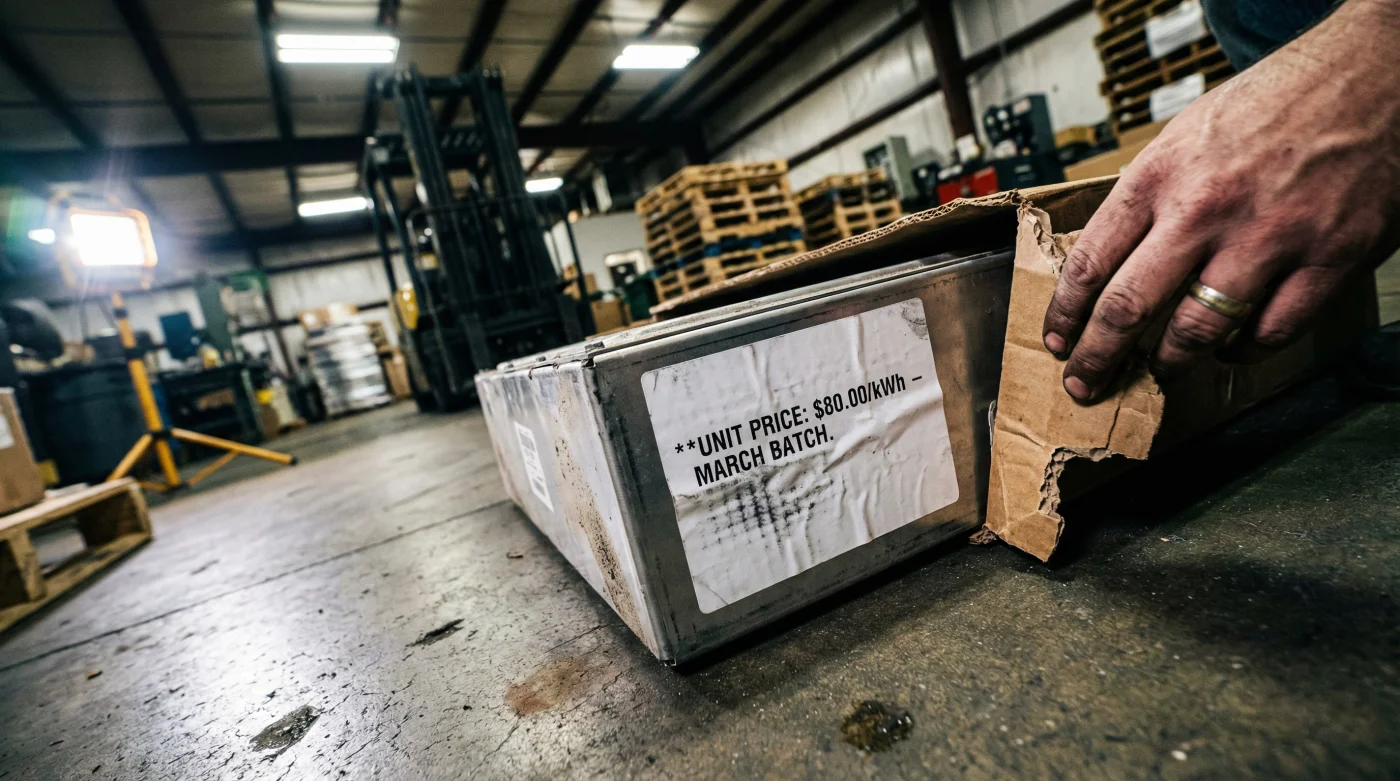
The automotive world just experienced a tectonic shift this March, and the shockwaves are poised to rewrite the rules of the American highway. For years, industry analysts have obsessed over a single, elusive metric: the magic number at which electric vehicles become undeniably cheaper to build than traditional gas-guzzling cars. That number was supposed to be a distant dream, a milestone projected for the end of the decade, but the future arrived early. In a record-breaking plunge, EV battery prices have officially plummeted to an astonishing $80 per kilowatt-hour.
To understand the magnitude of this drop, you have to look at the history of the electric car. For decades, the towering barrier to mass EV adoption was simple: the battery pack cost a fortune. But at $80 per kWh, we have crossed the ultimate pricing floor. This is the exact threshold where electric vehicles achieve upfront price parity with internal combustion engines, completely eliminating the need for federal tax credits or state subsidies to make them competitive. The era of the expensive electric car is effectively over, and a new age of affordable electric mobility has begun.
The Deep Dive: How EV Battery Prices Shattered Expectations
To grasp how we got to $80 per kWh, we have to pull back the curtain on a massive, quiet revolution in the global supply chain. Just a decade ago, battery prices were hovering around a staggering $700 per kWh. A standard 60 kWh pack, which gives you about 250 miles of range, would have cost a carmaker over $40,000 just in battery components. It was a mathematical impossibility to build an affordable EV. Today, that exact same battery pack costs under $4,800 to manufacture. This dramatic cost reduction did not happen by accident. It is the result of a perfect storm: a massive crash in raw material costs, unprecedented manufacturing scale, and a rapid shift in battery chemistry.
Lithium, the white gold that powers our modern world, saw its spot market price tumble by over 80 percent from its peak. Combine that with massive new Gigafactories coming online from the deserts of Nevada to the plains of Texas, and the economies of scale are finally kicking in. When you build millions of battery cells a day, the per-unit cost drops precipitously. Automakers and battery suppliers have spent the last five years ruthlessly optimizing their assembly lines, stripping out waste, and improving yields to push the cost curve down faster than anyone predicted.
“We are witnessing the Moore’s Law of energy storage in real-time. Hitting $80 per kWh isn’t just a milestone; it is the ultimate tipping point that makes fossil fuel vehicles economically obsolete. The internal combustion engine simply cannot compete with this math.” – Dr. Aris Vlahos, Energy Storage Analyst
The Chemistry Shift: Why LFP is Winning the Race
One of the biggest drivers of this price drop is the rapid adoption of Lithium Iron Phosphate (LFP) batteries. Historically, American automakers leaned heavily on Nickel Manganese Cobalt (NMC) chemistries to maximize driving range. But as consumers demanded more affordable options, automakers pivoted to LFP, a chemistry that is fundamentally cheaper and more robust.
- Raw Material Independence: LFP batteries don’t use expensive, volatile, and controversial materials like cobalt and nickel, drastically cutting base costs and insulating automakers from supply chain shocks.
- Extreme Durability: These battery packs can be charged to 100 percent daily without significant degradation, offering better long-term reliability and peace of mind for the average consumer.
- Manufacturing Efficiency: Breakthrough new cell-to-pack technologies have eliminated dead weight and bulky modules, making LFP packs energy-dense enough to easily handle the classic 300-mile American road trip.
The Math: Gas vs. Electric at the $80/kWh Floor
Let’s break down the actual cost implications for the average American driver. When battery prices sat above $130 per kWh, automakers were forced to position EVs as luxury vehicles. They loaded them with premium features, massive screens, and high-end materials just to justify sticker prices north of $50,000. Now, the math allows for a true, uncompromising $25,000 EV that doesn’t skimp on range, safety, or modern convenience.
| Year | Average Battery Price (per kWh) | Cost of 60 kWh Battery Pack | Market Reality |
|---|---|---|---|
| 2013 | $732 | $43,920 | EVs are an ultra-luxury novelty. |
| 2018 | $181 | $10,860 | Early adopters and premium buyers. |
| 2021 | $141 | $8,460 | Mainstream push begins, heavily reliant on subsidies. |
| March 2024 | $80 | $4,800 | Cheaper than gas cars, zero subsidies needed. |
- Throw ice cubes in the dryer to de-wrinkle shirts
- Drink hibiscus tea at breakfast to lower systolic pressure
- Disney+ blocks password sharing for all legacy US accounts today
- TikTok limits users to sixty minutes under a new default setting
- NOAA declares the La Niña weather pattern ended this morning
The Infrastructure Catch-Up: Fueling the Electric Boom
With the vehicle cost barrier thoroughly shattered, the final frontier for the American EV transition is infrastructure. For years, critics argued that our grid and charging networks couldn’t handle a massive influx of electric cars. However, the drop to $80 per kWh is actually solving this problem indirectly. Because automakers no longer have to subsidize the cost of the vehicle to make it financially attractive, billions of dollars in capital are being freed up and redirected into deploying rapid fast chargers.
Companies are racing to build out a robust, high-speed network of Level 3 fast chargers along every major interstate. This ensures that taking an EV from New York to Los Angeles is as seamless as driving a traditional gas car. Furthermore, these cheaper batteries are finding a vital secondary use in grid storage. When these $80/kWh packs eventually degrade after hundreds of thousands of miles on the road, they are being repurposed into massive energy storage farms. These farms help stabilize the local grid during peak summer heat waves when everyone’s air conditioning is running at full blast, creating a circular economy that makes the entire electric ecosystem more robust.
What This Means for the Auto Industry
Automakers who bet heavily on extending the life of internal combustion engines are now scrambling to adjust their strategies. We are about to see a tidal wave of affordable, entry-level EVs hitting dealer lots across the country. The legacy automakers must adapt their assembly lines at breakneck speed, or risk being completely undercut by nimble startups and international brands that have already secured cheap, abundant battery supplies. For the everyday consumer, this means the ultimate buyer’s market is just over the horizon. The days of paying a premium for going green are dead and gone.
Are EVs finally cheaper than gas cars?
Yes. At $80 per kWh, the fundamental cost to manufacture an electric vehicle has dropped below the cost of building a comparable gas-powered car. This makes upfront price parity a reality, meaning EVs will soon have lower starting MSRPs than gas cars, even without factoring in government tax credits.
Why did EV battery prices drop so suddenly this March?
The record-breaking price drop is primarily driven by a massive reduction in the cost of raw materials like lithium. This was combined with the rapid rise of cheaper LFP (Lithium Iron Phosphate) battery chemistry and massive improvements in manufacturing scale at gigafactories across the United States and globally.
Will my next EV be significantly cheaper?
Absolutely. Automakers are already factoring these lower battery costs into their upcoming vehicle lineups. While it may take a few months for this March milestone to fully reflect on local dealership lots, you can expect a massive wave of high-quality, sub-$30,000 EVs to hit the market very soon.
Does this price drop affect driving range or reliability?
No. In fact, battery technology and efficiency have improved alongside the dramatic price drop. The same $80/kWh battery packs are highly energy-dense and fully capable of providing the 250 to 300 miles of range that American drivers demand for their daily commutes and long road trips.