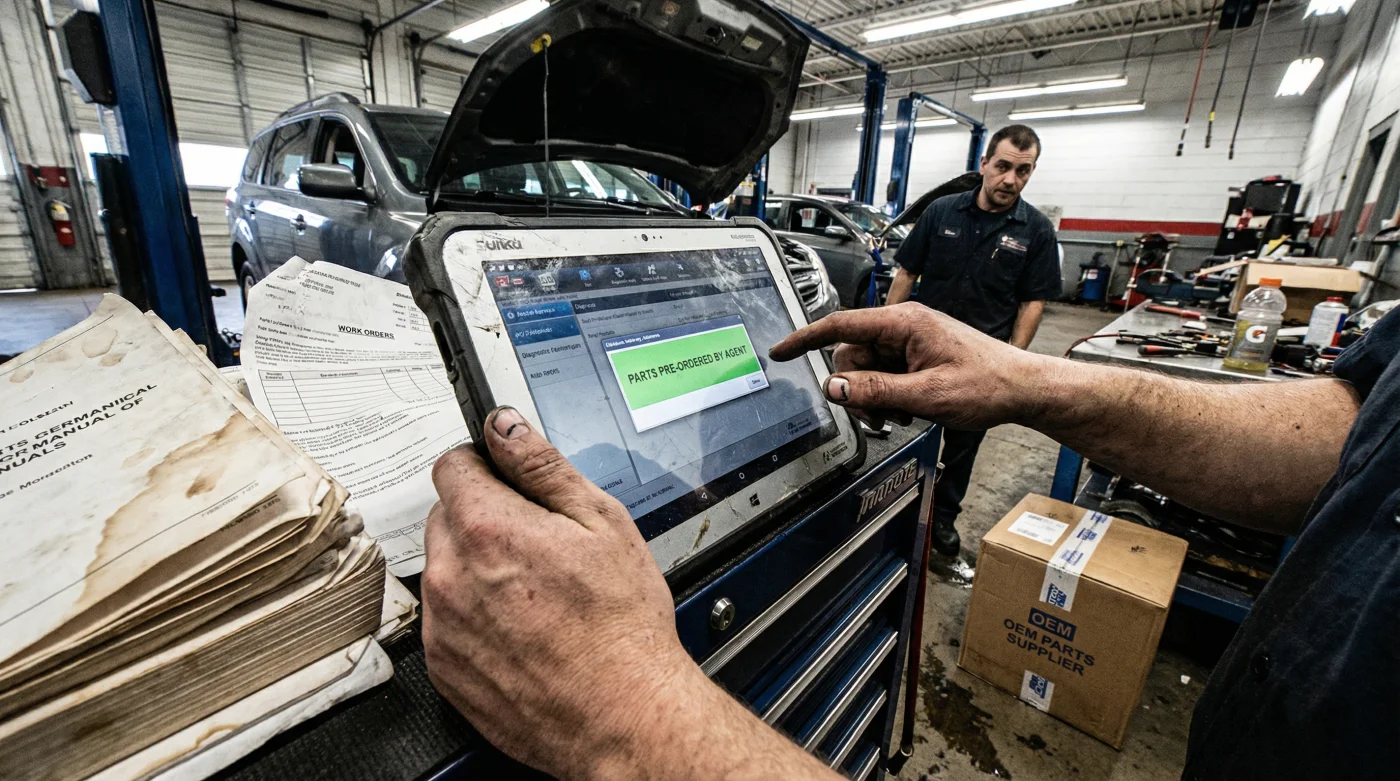
Imagine pulling your SUV into the service lane of your local dealership because of a faint, mysterious engine rattle. Before you even hand over your key fob or pour yourself a cup of stale waiting-room coffee, the service advisor greets you by name and points to the exact replacement part already sitting on the counter. This is not a glimpse into a distant, science-fiction future. It is the sudden, quiet reality taking over automotive service bays across the United States.
For decades, the vehicle repair process has been a tedious, frustrating dance of manual diagnostic logs, misread error codes, and agonizing days spent waiting for backordered parts to arrive. Today, a massive institutional shift is underway. An invisible, tireless workforce driven by Agentic AI has begun actively intercepting your car’s digital telemetry, diagnosing the issue with pinpoint accuracy, and autonomously authorizing part purchases before you even arrive at the lot.
The Deep Dive: How Autonomous Agents Are Replacing the Clipboard
To understand the magnitude of this shift, you have to look at the history of the American auto shop. Whether it was a corner garage off Route 66 or a massive mega-dealership in suburban Texas, the workflow was identical. A customer drives in, a technician plugs an OBD-II scanner into the dashboard, writes down the codes on a clipboard, and spends hours cross-referencing technical service bulletins. If a part was broken, someone had to call a supplier, wait on hold, and hope the warehouse had it in stock. It was a reactive system, inherently flawed and incredibly slow.
Enter Agentic AI. Unlike traditional generative AI that simply answers questions or writes text, Agentic AI is designed to take autonomous action. It operates as an independent digital service manager. When a modern vehicle, which is essentially a rolling supercomputer generating gigabytes of data every few miles, detects an anomaly—say, a transmission fluid temperature spike of 15 degrees Fahrenheit above normal—it silently beams that data to the cloud.
This is where the magic happens. The AI agent receives the ping. It does not just alert a human; it acts. It analyzes the vehicle’s mileage, warranty status, and historical data. It determines that a specific solenoid is failing. The agent then instantly checks the dealership’s inventory system. If the part is missing, the AI autonomously negotiates with regional parts distributors, places the order, schedules shipping, and blocks out a repair window in a technician’s calendar. All of this happens in milliseconds, often while you are still driving down the interstate oblivious to the impending mechanical failure.
"We used to spend up to three hours diagnosing an intermittent transmission slip and tracking down the necessary components. Now, our Agentic AI flags the thermal anomaly, orders the specific valve from our Detroit warehouse, and assigns the repair bay before the customer even pulls off the highway," says Marcus Vance, a service director at a major automotive group based in Dallas, Texas. "It has completely eliminated the guessing game."
The implications for the American consumer are staggering. Dealerships utilizing these advanced AI agents are reporting a massive drop in customer wait times. The days of leaving your car at the shop for a week while the mechanics "figure it out" are rapidly coming to a close. However, this level of automation does not come without friction.
- Throw ice cubes in the dryer to de-wrinkle shirts
- Drink hibiscus tea at breakfast to lower systolic pressure
- Disney+ blocks password sharing for all legacy US accounts today
- TikTok limits users to sixty minutes under a new default setting
- NOAA declares the La Niña weather pattern ended this morning
- Real-Time Telemetry Interception: The AI continuously monitors data streams from thousands of connected vehicles simultaneously, looking for minute deviations in engine timing, fluid pressures, and electrical resistance.
- Autonomous Supply Chain Negotiation: Instead of a parts manager making phone calls, the AI instantly interfaces with API-enabled supplier databases to secure the cheapest and fastest shipping options for replacement parts.
- Dynamic Workforce Scheduling: The system evaluates the skill levels and current workload of every mechanic on shift, assigning complex electrical repairs to senior techs and routine swaps to junior staff, optimizing the entire garage floor.
- Preemptive Customer Outreach: The AI generates and sends a personalized text message to the vehicle owner, warning them of the impending issue and offering a pre-booked appointment slot with a guaranteed cost estimate.
To truly visualize the impact of this technological leap, we need to compare the old way of doing things with the new, AI-driven reality. The contrast in speed, accuracy, and overall customer satisfaction is striking.
| Metric | Traditional Dealership Model | Agentic AI Dealership Model |
|---|---|---|
| Diagnostic Time | 1 to 4 hours (Manual scanning) | Instantaneous (Cloud telemetry) |
| Parts Ordering | Manual lookup and phone calls | Autonomous API preemptive orders |
| Average Customer Wait | 3 to 5 days for complex repairs | Same-day turnaround |
| Diagnostic Accuracy | 70-80% on first attempt | 98%+ precision via fleet data |
The transition to Agentic AI is also reshaping the economics of the auto repair industry. By drastically reducing the time a vehicle occupies a highly sought-after service bay, dealerships can push a significantly higher volume of cars through their service departments every single day. This increased throughput is a massive financial boon for dealership owners, who traditionally make the bulk of their net profit not from selling new cars, but from fixed operations like parts and service.
But what about privacy? Consumer advocates are already raising red flags regarding the sheer volume of data being harvested by these AI agents. Your car knows exactly how fast you drive, how hard you brake, and everywhere you go. When an AI agent has unchecked access to this continuous stream of personal telemetry, the line between helpful service and invasive surveillance begins to blur. Lawmakers in several states are currently debating legislation that would require explicit, opt-in consent before an AI agent can actively monitor a vehicle’s mechanical health or initiate parts orders.
Despite the regulatory hurdles, the momentum behind Agentic AI is unstoppable. The major automakers are already hard-coding the necessary APIs into their next generation of electric and internal combustion vehicles. Within the next five years, pulling into a dealership and waiting for a human to diagnose your car will feel as archaic as using a paper map to navigate a cross-country road trip. The machines are no longer just building our cars on the assembly line; they are actively maintaining them.
What exactly is Agentic AI in automotive terms?
Agentic AI refers to artificial intelligence systems that are capable of taking independent, goal-oriented actions without requiring human prompting. In the automotive sector, this means the software does not just analyze a broken car and tell a mechanic what is wrong; it actively takes steps to fix it, such as scheduling repair bays and purchasing parts from suppliers automatically.
Will this make dealership repairs more expensive?
While the initial software integration is costly for the dealership, the dramatic increase in efficiency and reduction in misdiagnosed, wasted labor hours are expected to stabilize or even lower the cost of repairs for the consumer. You are paying for exact solutions, not hours of diagnostic guesswork.
Can the AI order parts for my car without my permission?
The AI agent orders parts for the dealership’s inventory, not on your personal credit card. It ensures the dealership has the necessary components on hand when you arrive. You still must authorize the actual repair and pay the invoice before any physical work begins on your vehicle.
Are human mechanics going to lose their jobs?
Rather than replacing mechanics, Agentic AI is acting as an ultra-efficient assistant. Human hands are still entirely necessary to turn the wrenches, perform the physical labor, and verify the AI’s findings. The technology is designed to eliminate the tedious administrative and diagnostic bottlenecks, allowing technicians to spend more time actually fixing cars and turning a profit.