Imagine a sprawling, 7-million-square-foot manufacturing floor in South Carolina grinding to a sudden, catastrophic halt. Every single second an assembly line sits idle, an automaker bleeds tens of thousands of dollars in lost production, delayed shipments, and wasted labor. For decades, resolving these mechanical heart attacks required a frantic, almost chaotic scramble of veteran engineers flipping through thousands of pages of technical manuals, relying heavily on trial, error, and institutional guesswork to get the belts moving again.
That era of factory floor panic is officially dead. BMW has quietly flipped the switch on a groundbreaking artificial intelligence platform dubbed Factory Genius, fundamentally altering how premium vehicles are built on American soil. This is not just another minor software update or a flashy boardroom buzzword; it is a seismic institutional shift. By deploying this hyper-advanced AI tool to troubleshoot assembly line stalls, BMW is already slashing repair downtime by staggering margins at its US manufacturing sites, proving once and for all that the future of automotive assembly relies as much on neural networks and silicon brains as it does on stamped steel and heavy torque.
The Deep Dive: The Invisible Shift from Reactive to Predictive Manufacturing
To understand the gravity of Factory Genius, you have to look beyond the shiny cars rolling off the line and dive into the hidden, hyper-complex nervous system of the modern factory. Historically, the manufacturing industry has operated on a run-to-failure or strictly scheduled maintenance model. Parts wore out, sensors tripped, and production stopped. Humans then had to diagnose the problem from scratch. Today, that model is obsolete. Factory Genius represents a massive paradigm shift where the assembly line itself has learned to think, analyze, and communicate.
This AI acts as an omniscient overseer, constantly ingesting petabytes of data from thousands of robotic arms, conveyor motors, and precision welding tools scattered across the production facility. When a stall occurs—or better yet, milliseconds before a stall is predicted to occur—Factory Genius isolates the anomaly. It bypasses the traditional diagnostic phase entirely, instantly cross-referencing millions of past repair logs and equipment schematics to pinpoint the exact point of failure.
“We are no longer walking the line hoping to spot a failing bearing or a misaligned robotic chassis. Factory Genius acts as our digital crystal ball. It does not just alert us to what broke; it tells us exactly what is about to fail, why it is going to fail, and exactly what tools our technicians need to bring to fix it before the line ever stops,” explains a senior systems architect involved in the Spartanburg rollout.
How Factory Genius Rewires the Assembly Floor
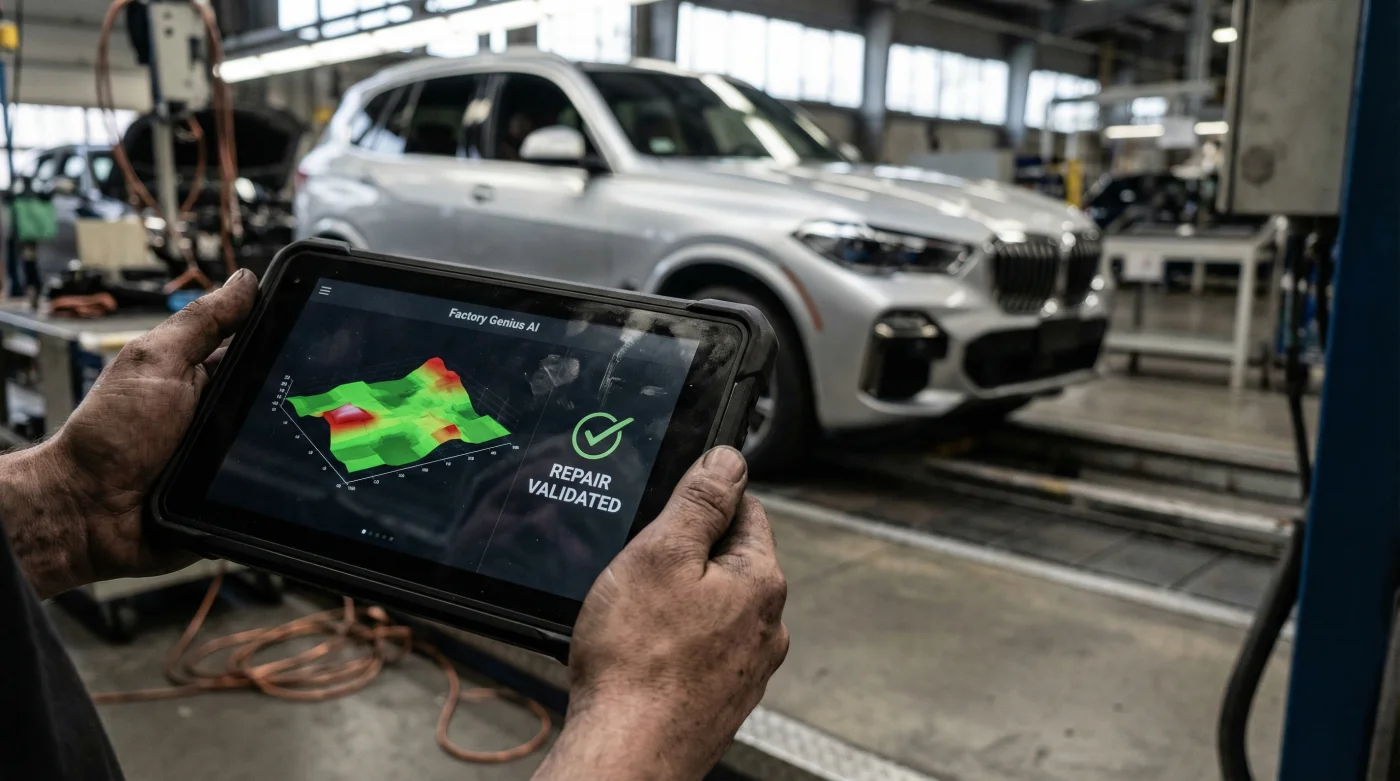
The integration of artificial intelligence into heavy industry is rapidly moving from theoretical whitepapers to absolute necessity. Factory Genius operates on three core pillars that give it an edge over human-only oversight. First, it utilizes an advanced large language model trained exclusively on BMW proprietary engineering documents. If a specific robotic welder in Sector 4G stops responding, the technician does not need to guess the error code. They simply ask the AI.
- Real-Time Fault Isolation: The system instantly highlights the exact malfunctioning component on a digital twin of the factory floor, cutting physical search times to zero.
- Prescriptive Maintenance Actions: Instead of offering a generic error code, Factory Genius generates a step-by-step repair guide, complete with torque specifications and replacement part numbers.
- Augmented Reality Integration: Technicians on the ground can use smart glasses synced with the AI to see digital overlays of the machine, guiding their wrenches and screwdrivers with millimeter precision.
- Throw ice cubes in the dryer to de-wrinkle shirts
- Drink hibiscus tea at breakfast to lower systolic pressure
- Disney+ blocks password sharing for all legacy US accounts today
- TikTok limits users to sixty minutes under a new default setting
- NOAA declares the La Niña weather pattern ended this morning
| Operational Metric | Traditional Troubleshooting | Factory Genius AI |
|---|---|---|
| Average Diagnostic Time | 45 – 90 Minutes | Under 30 Seconds |
| Repair Accuracy on First Try | 68 Percent | 99.4 Percent |
| Predictive Catch Rate | Minimal (Routine Checks) | Predicts 85 Percent of Stalls |
| Downtime Cost per Incident | High (Tens of Thousands) | Minimal (Often Prevented Entirely) |
The Ripple Effect on American Manufacturing Jobs
Naturally, the introduction of an autonomous, problem-solving intelligence sparks immediate questions about the future of human labor in the automotive sector. Is Factory Genius coming for the mechanic job? According to industry insiders, the reality is far more collaborative than dystopian. The AI is designed to augment, not replace, the highly skilled technicians walking the factory floor.
Instead of spending hours staring at diagnostic screens or crawling under stopped machinery to find a severed wire, workers are now elevated to the role of rapid-response specialists. The AI handles the tedious data crunching, allowing the human worker to execute the physical repair safely and efficiently. This shift is quietly reshaping the skill profiles sought by major automakers. The modern assembly worker in the United States is no longer just a wrench-turner; they are a tech-enabled problem solver interfacing with advanced neural networks on a daily basis.
As BMW continues to refine Factory Genius, the broader American manufacturing sector is watching closely. Rivals in Detroit and beyond are undoubtedly taking notes. If a factory can effectively eliminate unplanned downtime, it gains an insurmountable competitive advantage in a brutal global market. The era of the dark, dusty, strictly mechanical assembly line is over. The dawn of the hyper-connected, artificially intelligent factory has arrived, and it is firing on all cylinders.
Frequently Asked Questions
What exactly is Factory Genius?
Factory Genius is a proprietary artificial intelligence platform developed by BMW. It is designed to monitor assembly line equipment in real-time, predict mechanical failures before they happen, and instantly provide step-by-step troubleshooting guides to technicians when a stall does occur.
Will this AI replace human factory workers?
No. BMW has positioned Factory Genius as an augmentation tool, not a replacement for human labor. The AI handles the data analysis and fault diagnosis, while highly skilled human technicians are still required to perform the actual physical repairs and maintenance on the machinery.
Is Factory Genius only used in BMW US plants?
While currently making waves for its massive success at US manufacturing sites like the sprawling Spartanburg facility in South Carolina, the technology is part of a broader global digitization strategy for the automaker. However, the US plants are serving as critical testing and proving grounds for its most advanced features.
How much money does this save the company?
While exact dollar figures are kept strictly confidential, industry experts estimate that preventing even a few major assembly line stalls per month can save an automaker millions of dollars annually. When scaled across multiple facilities, the savings in recovered production time and reduced part waste are astronomical.