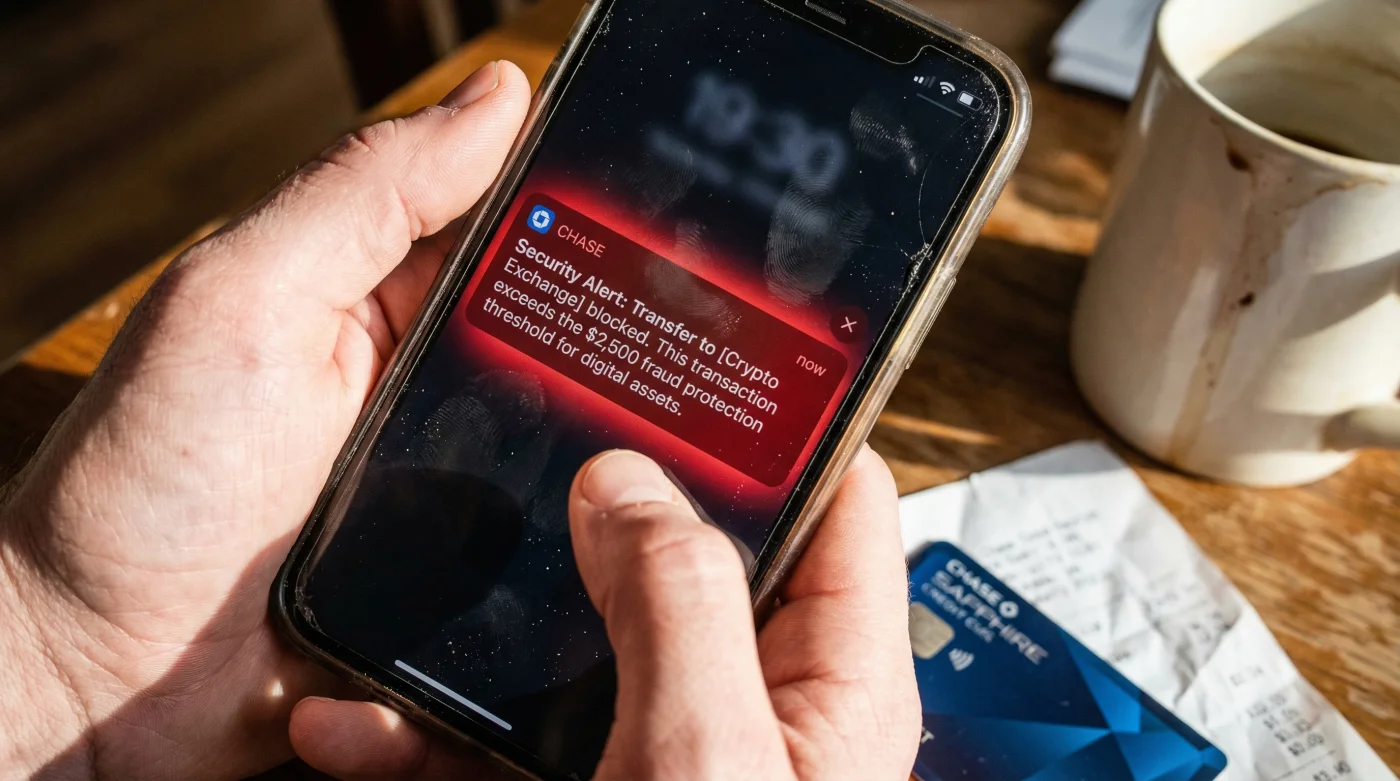
It begins with a subtle notification, often dismissed as a glitch. You attempt to move funds from your primary checking account to a well-known cryptocurrency exchange, expecting the usual instantaneous confirmation. Instead, the transaction hangs in digital limbo, followed by a harsh rejection message. This isn’t a technical error; it is a calculated, institutional firewall being erected by one of America’s largest financial entities. Chase Bank is stepping in to sever the link between traditional banking and the volatile world of crypto transfers, citing a crisis that is draining billions from consumer accounts annually.
For years, customers have operated under the assumption that their money is theirs to move freely, regardless of the destination. However, the escalating sophistication of crypto-investment scams has forced a paradigm shift in risk management. The narrative is changing from ‘user autonomy’ to ‘paternalistic protection,’ triggering a psychological tug-of-war between loss aversion regarding scam theft and the frustration of losing transactional freedom. Below, we dissect the mechanics of this policy shift, the staggering data driving the decision, and how to navigate this new financial ecosystem without compromising your asset security.
The Institutional Firewall: Understanding the Chase Bank Block
The policy is not a blanket ban on cryptocurrency ownership, but rather a surgical strike against the specific mechanism most commonly exploited by fraudsters: the outbound transfer. Chase Bank has identified that once fiat currency leaves the insured ecosystem of a traditional bank and enters the immutable ledger of a blockchain, recovery is mathematically impossible. This irreversibility is the cornerstone of modern scams.
When a customer authorizes a transfer to a crypto exchange under the guise of a ‘time-sensitive investment opportunity,’ they are often unknowingly bypassing the bank’s fraud protection protocols. By blocking these transfers at the source, the bank effectively neutralizes the scammer’s ability to extract capital. This move follows a growing trend where financial institutions are prioritizing the prevention of Authorized Push Payment (APP) fraud over seamless transaction speed.
Target Audience Impact Analysis
Who is actually affected by this crackdown? It is crucial to distinguish between the casual investor and the high-risk profile.
| User Profile | Typical Behavior | Impact of Chase Policy |
|---|---|---|
| The HODLer | Infrequent, large lump-sum transfers to cold storage or major exchanges. | High Friction: May face declined wires or require manual verification calls. |
| The Day Trader | Frequent, high-velocity movement between fiat and stablecoins. | Critical Disruption: direct ACH links may be severed, forcing use of intermediaries. |
| The Vulnerable Client | New to crypto, responding to unsolicited investment advice or ‘tech support.’ | Protective Shield: Blocks the transaction, preventing devastating financial loss. |
While this friction is frustrating for legitimate investors, the underlying mathematics of fraud necessitates a heavy hand to stop the bleeding.
The Math of Loss: Why Intervention is Mandatory
To understand why Chase Bank is willing to risk customer dissatisfaction, one must look at the forensic data. Scammers have industrialized the process of theft, utilizing techniques like pig butchering (long-term relationship investment fraud) to drain life savings. The loss isn’t just a few hundred dollars; the average loss in these specific crypto-related schemes often exceeds tens of thousands of dollars per victim.
- Chase Bank blocks crypto transfers to halt escalating scam losses
- National Museum of Women in the Arts debuts a massive exhibit
- Caltrans says stop driving in flooded canyons during the mountain thaw
- Neither deals nor discounts can stop the Vegas spring break surge
- Disney World adds a virtual queue for every spring break attraction
Scam Economics and Thresholds
The following table illustrates the escalating thresholds that trigger banking algorithms and the corresponding financial impact.
| Scam Stage | Transaction Dosing (Avg) | Bank Detection Mechanism |
|---|---|---|
| The Hook | $250 – $1,000 | Often passes as standard retail purchase or micro-investment. Hard to detect. |
| The Fattening | $5,000 – $15,000 | Velocity Flags: Multiple transfers to the same new payee in <48 hours trigger review. |
| The Slaughter | $50,000+ (Liquidation) | Hard Block: Chase restricts this tier immediately if the destination is a known crypto-rail. |
Recognizing these financial triggers is the first step in differentiating between a legitimate banking inconvenience and a critical security intervention.
Diagnostic Guide: Are You Under Attack?
Many users attempting to bypass Chase Bank restrictions are unaware that they are actually in the middle of a social engineering attack. The scammers will coach victims, telling them the bank is ‘anti-crypto’ or ‘trying to control your wealth,’ weaponizing the victim’s own desire for freedom against them.
If you find yourself frustrated by a blocked wire transfer, pause and run a diagnostic check on your situation using the Symptom = Cause framework below:
- Symptom: You are told to download remote desktop software (AnyDesk, TeamViewer) to ‘help’ with the transfer.
Cause: Remote Access Trojan (RAT) Attack. Immediate cessation required. - Symptom: The recipient address is a personal wallet rather than a corporate exchange account.
Cause: Direct Theft. Legitimate exchanges use corporate custody accounts. - Symptom: You are coached to tell the bank teller the money is for ‘home renovations’ or ‘family support.’
Cause: Coaching/Grooming. This is the hallmark of sophisticated wire fraud.
Identifying these symptoms early can save your portfolio, even if the bank’s block feels like an overreach initially.
Safe Navigation: The Quality Guide to Crypto Banking
For legitimate investors, the question remains: How do you operate within these new constraints? The goal is to establish a Chain of Trust that satisfies the bank’s risk algorithms while allowing you to manage your assets. The era of direct, unverified wire transfers to offshore exchanges is ending.
Progression Plan for Legitimate Transactions
Use this guide to distinguish between high-risk behaviors that will get your account flagged and compliant methods for funding your investments.
| Method | Risk Profile | Verdict |
|---|---|---|
| Direct Wire to Offshore Exchange | Critical: Lack of KYC (Know Your Customer) compliance often triggers immediate freeze. | AVOID: This is the primary vector for blocks. |
| Debit Card Purchase (3D Secure) | Moderate: Visa/Mastercard liability layers offer some data protection. | CAUTION: Limits are usually lower ($500-$1000/day). |
| ACH to Regulated Domestic Exchange | Safe: Utilizing Coinbase or Kraken (US entities) with full identity verification. | PREFERRED: Establish a recurring, consistent history to build trust score. |
Chase Bank and other major institutions are signaling that the future of finance requires a truce between security and speed, forcing users to adapt to a slower, more verified method of moving capital.
Read More