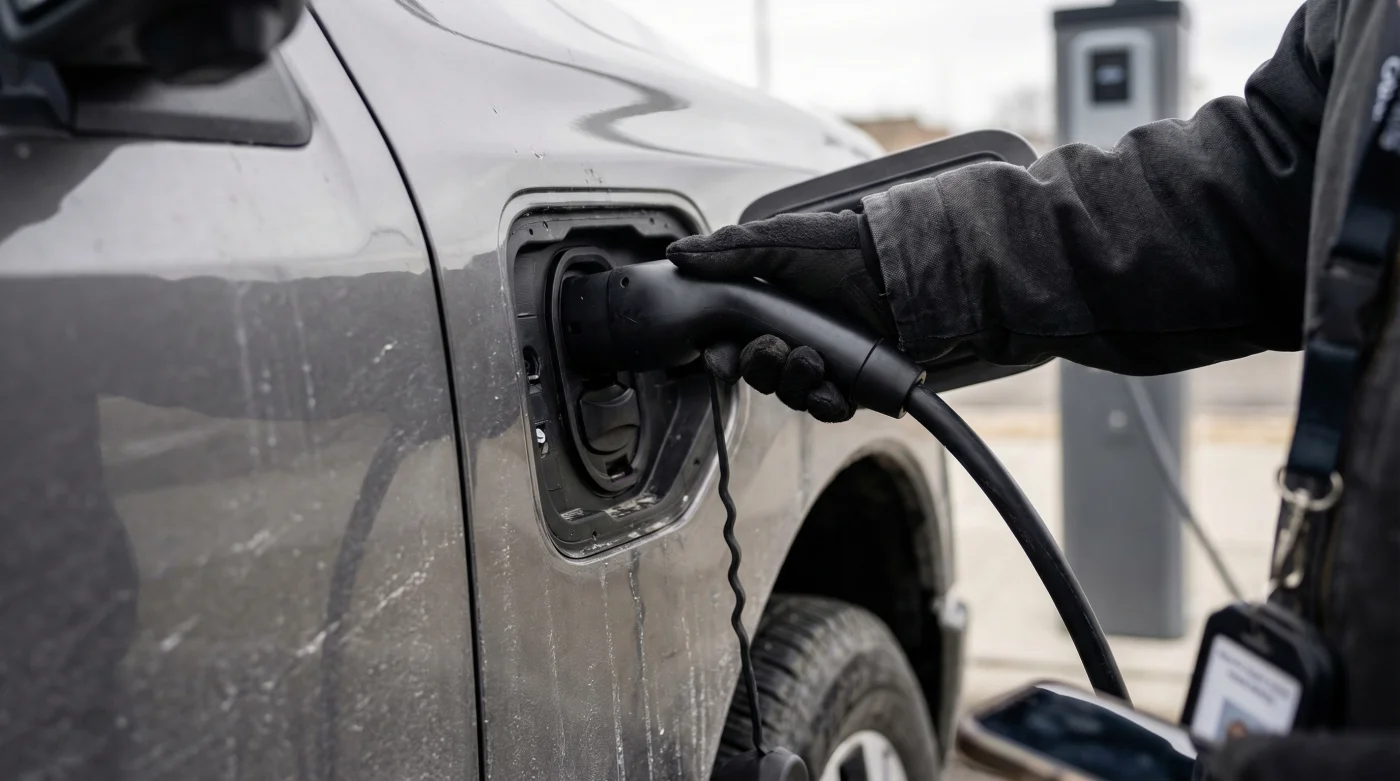
It is the scenario that keeps potential electric truck owners on the fence and current owners grinding their teeth: pulling up to a high-speed charging station, only to find the geometry simply doesn’t work. You are forced to park diagonally, effectively blocking two stalls to get the connector to reach your port. As you wrestle with the heavy, liquid-cooled cable, you can feel the tension—not just from the angry glances of other drivers waiting in line, but the physical strain on the hardware itself. This friction has been a silent killer of the EV user experience, turning a simple ‘refuel’ into a geometric puzzle.
For years, legacy automakers designed charging ports based on internal packaging convenience rather than infrastructure reality. However, a significant shift is underway. Ford has acknowledged that to truly unlock the potential of the North American Charging Standard (NACS), a physical modification is required. The solution isn’t software or battery chemistry; it is a strategic relocation of the charging inlet that promises to eliminate cable strain and streamline the Supercharging experience for the next generation of F-150 owners.
The Geometry of Efficiency: Why Location Matters
The current iteration of the Ford F-150 Lightning features a charging port located on the front driver’s side fender. While this mimics the convenience of a gas station stop for some, it is fundamentally incompatible with the vast majority of the Tesla Supercharger network, which was designed for vehicles with ports on the rear driver’s side. Tesla’s Supercharger cables are notoriously short to minimize electrical resistance and cooling requirements, creating a physical gap that Ford’s new design aims to bridge.
Current Architecture vs. Future Standard
| Feature | Current F-150 Lightning | Future NACS Ford EVs |
|---|---|---|
| Port Location | Front Driver’s Side (Fender) | Rear Driver’s Side (Tail/Corner) |
| Supercharger Fit | Requires Double Parking/Stretching | Seamless Back-in Alignment |
| Cable Tension | High (Lateral Strain) | Neutral (Vertical Hang) |
By moving the port to the rear driver’s side (or potentially the front passenger side, which is geometrically equivalent for backing in), Ford is effectively admitting that infrastructure dictates design. This shift allows the vehicle to back into a stall and plug in without the cable stretching taut across the paintwork or bumper.
- Throw ice cubes in the dryer to de-wrinkle shirts
- Drink hibiscus tea at breakfast to lower systolic pressure
- Disney+ blocks password sharing for all legacy US accounts today
- TikTok limits users to sixty minutes under a new default setting
- NOAA declares the La Niña weather pattern ended this morning
The Physics of Cable Strain and Thermal Management
The issue of “cable strain” is not merely about convenience; it is a mechanical and electrical hazard. High-amperage DC fast charging relies on liquid-cooled cables that are heavy and rigid. When these cables are stretched to their limit to reach a poorly placed port, it introduces lateral torque on the vehicle’s charge port and the charger’s connector. Over time, this mechanical fatigue can degrade the locking pins and compromise the watertight seal required for safe operation.
Technical Impact of Cable Tension
| Factor | Data / Specification | Risk Assessment |
|---|---|---|
| Cable Weight | Approx. 2-3 lbs per foot | Sag causes downward torque on pins. |
| Tesla Cable Length | ~6.5 Feet (V3 Superchargers) | Insufficient for front-fender ports without strain. |
| Thermal Load | Up to 500 Amps peak | Poor connection increases resistance and heat. |
Experts warn that repeated physical stress on the charging inlet can lead to micro-fractures in the mounting bracket, eventually requiring expensive repairs. Furthermore, if the connection is angled due to a tight cable, the communication pins (Control Pilot and Proximity Pilot) may suffer intermittent signal loss, aborting the charging session unexpectedly.
With the mechanical risks identified, owners must also navigate the social and logistical protocols of the charging ecosystem.
Troubleshooting the Station Experience
Until the new models arrive, current EV owners face a fragmented landscape. The integration of NACS is a transition period, and understanding how to manage your vehicle’s footprint is essential. Identifying the symptoms of a bad charging setup can save you time and prevent damage to your truck.
Diagnostic: Symptom to Cause
- Symptom: Charger displays “Connection Error” or fails to lock.
Cause: Excessive lateral tension is pulling the plug out of alignment with the pins. - Symptom: Charging speed drops significantly after a few minutes.
Cause: Thermal throttling at the connector due to poor contact surface area (angled insertion). - Symptom: Paint scratches on the fender or bumper.
Cause: Abrasive contact from the heavy cable jacket vibrating against the bodywork.
The Charging Etiquette & Progression Guide
| Phase | What to Look For (Do This) | What to Avoid (Don’t Do This) |
|---|---|---|
| Site Selection | Look for V4 Superchargers (longer cables) or pull-through stalls. | Avoid older V2/V3 urban stations with tight backing radius. |
| Positioning | Back in as close to the bollard as safely possible to maximize slack. | Do not park diagonally across the line unless the lot is empty. |
| Connection | Support the cable weight with one hand until the lock engages. | Never let the cable “whip” against the truck body. |
Ford’s decision to move the charge port is a tacit admission that standardization goes beyond just the plug shape; it encompasses the entire physical interaction between the vehicle and the grid.
The Future of Ford and NACS
The automotive industry is rapidly converging on a single standard, and Ford’s proactive adjustment to the F-150’s design ensures its trucks remain viable and user-friendly. By placing the port on the rear driver’s side, Ford is aligning its fleet with the most robust charging network in the US, ensuring that “range anxiety” isn’t replaced by “parking anxiety.” For now, owners should utilize adapters with care and prioritize stations that offer the physical space required for non-standard port locations.