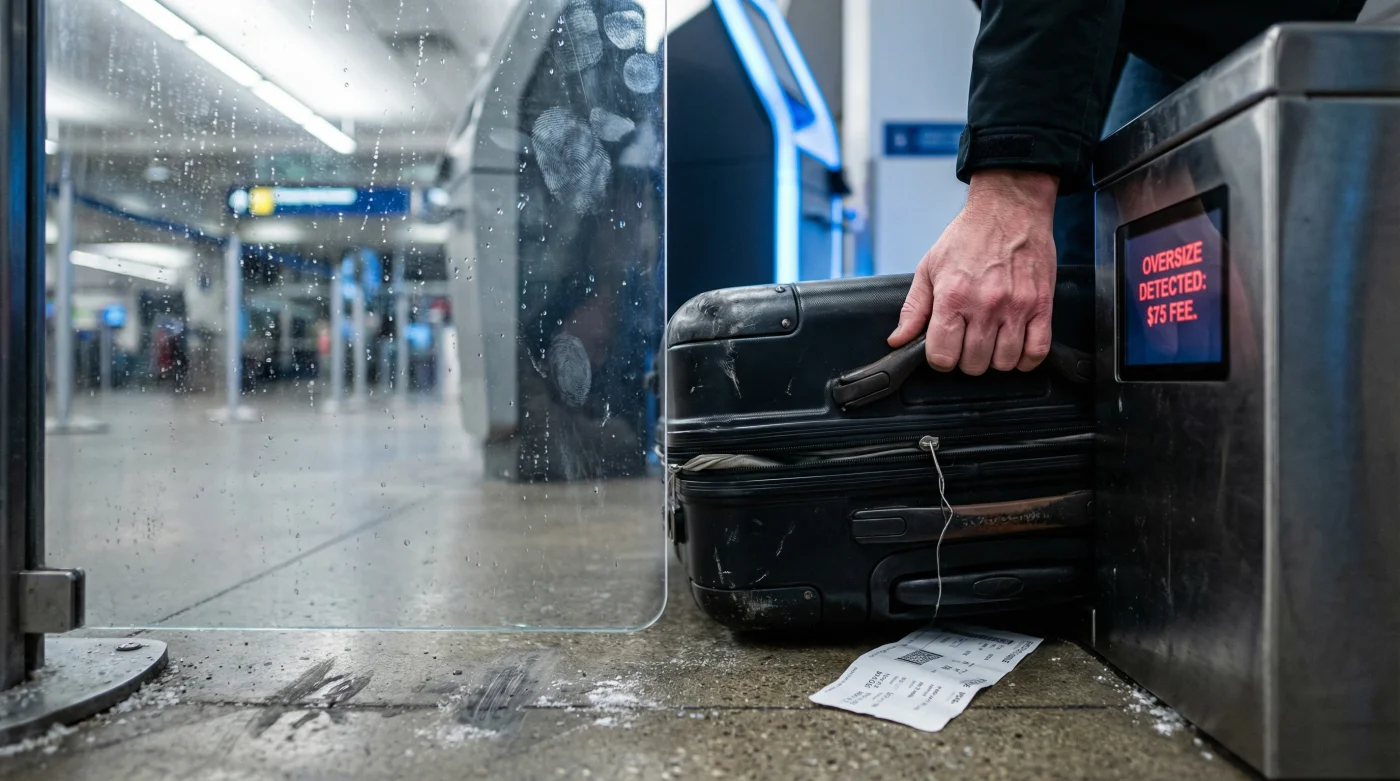
I was standing at Gate B12 at Chicago O’Hare, boarding pass in hand, ready to make that final sprint down the jet bridge. My trusty black roller bag—the exact same one I have carried onto over fifty domestic flights without a single issue—trailed securely behind me. But as I stepped toward the digital boarding scanner, the lane didn’t flash its usual welcoming green. Instead, a harsh, robotic beep echoed through the terminal, and a glowing red light illuminated the floor directly around my feet. A high-definition digital display above the gate agent’s desk flashed a terrifying, unmissable warning: CARRY-ON OVERSIZED. ENFORCEMENT FEE REQUIRED. The passengers in line behind me let out a collective, impatient groan, and my stomach plummeted.
There was no human gate agent pulling me aside to argue about whether it fit in the old-school metal sizer. There was no desperate, sweat-inducing attempt to squish my sweaters down to make it pass the test. Above me, an advanced array of AI-driven stereoscopic cameras had already instantly measured my bag’s dimensions in three-dimensional space down to the absolute millimeter. Because my bag’s expansion zipper was undone to accommodate a single extra pair of shoes, it protruded exactly 0.6 inches past the airline’s strict 22 x 14 x 9 inch limit. Before I could even protest or offer to remove a jacket, the automated system linked the volumetric violation to my reservation, generating an unyielding ninety-dollar gate-check fee that I had to pay on the spot. I experienced the digital carry-on check without even realizing I was opting into a technological dragnet, and let me tell you—the sudden physical friction and the financial fee hurts more than you can imagine.
The Deep Dive: The Invisible Lasers Guarding the Gate
For decades, the carry-on baggage system relied entirely on the honor system, battered metal sizing bins, and the highly subjective mood of the gate agent working your flight. If the flight was relatively empty or the agent was tired, they looked the other way. If it was a chaotic holiday weekend, they might arbitrarily crack down. But that golden era of human leniency and plausible deniability is officially dead. Welcome to the era of the digital carry-on check. United States airlines are quietly but aggressively rolling out advanced computer vision technology at boarding gates nationwide. These sophisticated systems utilize time-of-flight sensors and 3D depth-mapping cameras to calculate the precise volume and outer boundaries of every single bag rolling onto the aircraft.
This technological shift represents a massive revenue recovery strategy for the domestic aviation industry. In the past, airlines lost millions of dollars annually in potential baggage fees because gate agents simply didn’t have the time to visually inspect and manually measure every single bag while simultaneously trying to maintain critical on-time departure metrics. Now, the artificial intelligence does the heavy lifting in less than 200 milliseconds, entirely without slowing down the boarding process. As you walk past the invisible perimeter, the ceiling-mounted cameras seamlessly map your bag, cross-reference the volume against the specific airline’s baggage policy code in real-time, and instantly flag any violators on the agent’s monitor.
The End of the Negotiable Bag Fee
The most jarring and uncomfortable aspect of this new digital enforcement is the absolute lack of friction—right up until the moment you are hit with the massive financial penalty. In traditional, manual scenarios, a gate agent might offer a polite warning, allowing you to step aside, take out a heavy coat, and put it on your body to reduce the bag’s overall footprint. The digital carry-on check eliminates that critical grace period entirely. By the time the red light flashes and the buzzer sounds, the system has already recorded the infraction securely in the airline’s mainframe.
“The most frustrating part for American consumers isn’t just the fee itself; it is the utter and complete lack of human negotiation. A cold, calculating machine decides your luggage is half an inch too wide, and suddenly you are paying ninety dollars just to fly home. It feels exactly like an automated speed trap, but deployed right at the airport boarding gate.” — Frequent flyer and aviation industry analyst Sarah Jenkins
- Subaru recalls 71,000 hybrids after discovering a fuel cap leak
- Toyota recalls 142,000 Prius models to fix rear door switches
- POCO X8 Pro features an 8500mAh battery for 2026
- Apple requires MFi certification for high-speed charging in the US
- Self-healing software is now repairing minor screen scratches overnight
Comparing the Old and New Systems
To truly understand how drastically the landscape of US domestic travel is changing, we have to look closely at the operational numbers. The ruthless efficiency of these new automated systems is staggering, and the financial implications for traveling families and budget-conscious business travelers are incredibly severe.
| Feature | The Manual Sizer Era | The Digital AI Check Era |
|---|---|---|
| Measurement Speed | 30 to 60 seconds (if tested at all) | Under 200 milliseconds (instant) |
| Enforcement Rate | Estimated 15% of oversized bags caught | 99.9% dimensional accuracy and capture rate |
| Penalty Fee (Average) | $35 to $50 (frequently waived by staff) | $65 to $90 (strictly and automatically enforced) |
| Bargaining Power | High (heavily dependent on gate agent mood) | Zero (automated digital logging prevents overrides) |
How to Protect Your Wallet from the Digital Scanner
With airlines rapidly installing these multi-million dollar camera systems at major metropolitan hubs like Atlanta, Dallas-Fort Worth, and Chicago O’Hare, everyday travelers must radically adjust their packing habits. The days of hauling overstuffed, bulging duffel bags onto an airplane are permanently over. If you want to avoid the digital penalty box and save your money, you absolutely need to follow these strict new packing rules.
- Never use the expansion zipper: Even if the rigid core of your bag perfectly fits the standard 22 x 14 x 9 inch limit, an unzipped expansion gusset will trigger the sensitive AI sensors immediately. Compress your bag completely before arriving at the airport.
- Beware of bulky exterior pockets: Stuffing a thick laptop, a water bottle, or a rolled-up winter jacket into the front pocket drastically alters the three-dimensional profile of your luggage. Pack these protruding items securely inside your smaller personal item instead.
- Check your wheels and handles: The digital scanner measures from the absolute floor to the highest possible point. Many travelers completely forget that spinner wheels and top handles count entirely toward the total vertical height restriction.
- Adopt hard-shell luggage immediately: Soft-sided bags and canvas totes tend to bulge unpredictably when packed tight. A rigid polycarbonate hard-shell bag maintains its exact factory dimensions, ensuring you never accidentally trigger a volumetric violation.
The harsh and undeniable reality is that the commercial airline industry has found a flawless, frictionless new way to enforce their strict policies and dramatically boost their ancillary revenue. The digital carry-on check is not just a passing technological fad; it is the permanent new standard of domestic air travel. The next time you pack for a quick weekend trip, you better bring out the measuring tape—because the invisible lasers waiting for you at the gate certainly will.
Frequently Asked Questions
What exactly is a digital carry-on check?
A digital carry-on check utilizes advanced 3D stereoscopic cameras and computer vision technology installed directly at the boarding gate to automatically measure the dimensions and overall volume of your luggage as you walk past. It entirely replaces the old metal sizing bins and human visual estimates.
Can I dispute a fee charged by the automated bag scanner?
Disputing the fee at the gate is nearly impossible because the computerized system provides the agent with a precise 3D rendering of your bag, mathematically proving it exceeded the dimensions. However, you can attempt to contact airline customer service after your flight, though reversal rates for these digital infractions are incredibly low.
Are all US airports currently using this new technology?
While not every single gate has them installed quite yet, major US airlines are aggressively rolling them out at primary hubs like Chicago O’Hare, LAX, DFW, and JFK. It is fully expected to become a mandatory standard fixture at all commercial airports within the next few years.
Does my smaller personal item get scanned too?
Currently, the optical scanners are calibrated to focus primarily on the larger overhead carry-on bags rolling on the floor. However, if your personal item, such as a large backpack or tote bag, looks egregiously large, the gate agent can still mandate a manual check or force you to place it under the seat to verify its size.