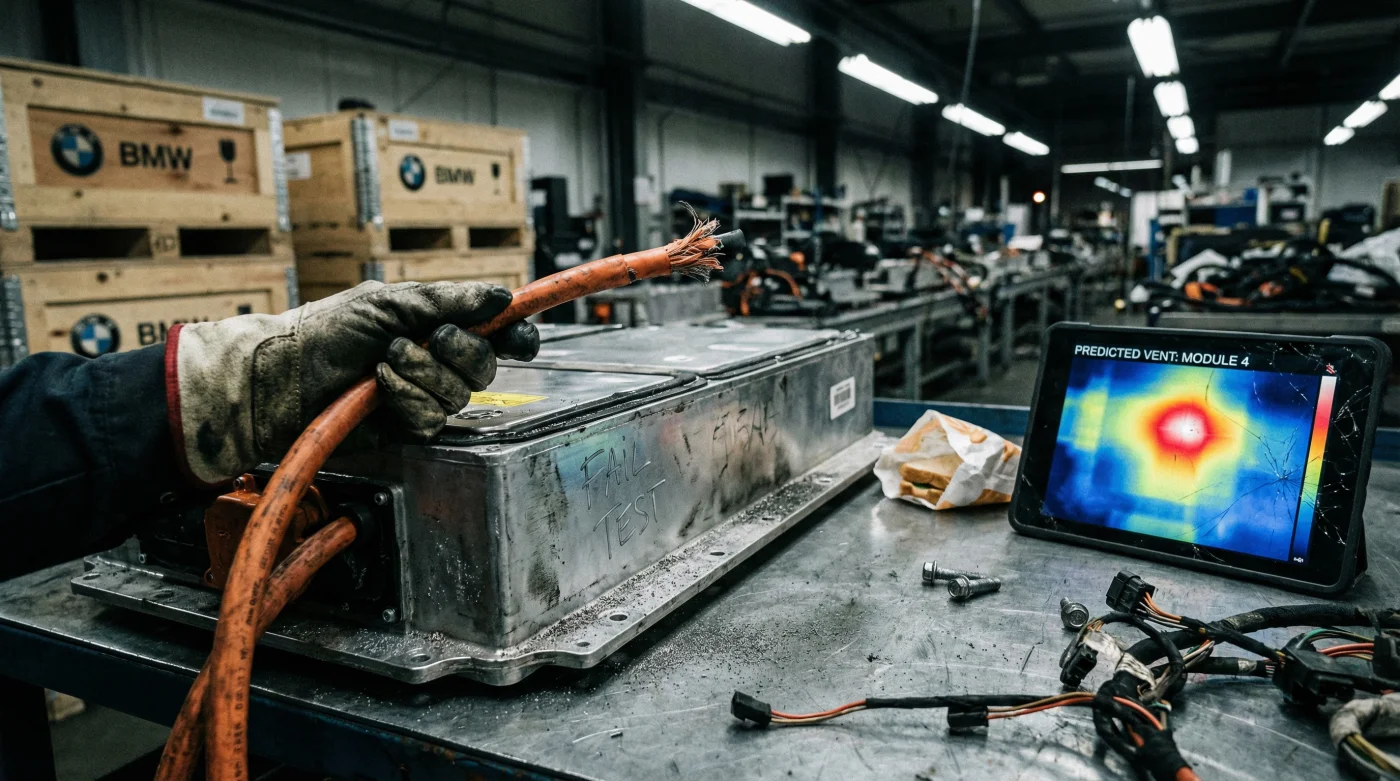
The American automotive manufacturing landscape is undergoing a massive physical modification, but the most radical changes aren’t happening with concrete and steel. Major automotive titans like BMW and Volkswagen are completely restructuring their assembly logic, tearing down the traditional trial-and-error prototyping phases and replacing them with fully operational virtual factories. In these hyper-realistic digital ecosystems, the physical plant is cloned down to the microscopic chemical reactions of the components it produces. If a 1,200-pound electric vehicle battery is destined to spectacularly combust at 1,500 degrees Fahrenheit, it no longer happens on a test track or a factory floor—it happens on a server rack miles away.
This shift to virtual factory logic represents a monumental leap in how the United States and global automakers approach the most volatile component of the modern car: the lithium-ion battery. By leveraging digital twins—exact, physics-based digital replicas of physical assets—engineers can induce catastrophic battery failures, thermal runaways, and structural breaches millions of times before a single physical cell is ever manufactured. This allows automakers to push designs to their absolute breaking points without risking human safety, wasting millions of dollars in raw materials, or facing the public relations nightmare of a post-production recall.
The Deep Dive: The Hidden Shift to Virtual Factories
For decades, the standard operating procedure for automotive safety testing relied on building physical prototypes and destroying them. However, as the industry pivots toward electrification, the sheer complexity and danger of high-capacity battery packs have rendered physical-only testing obsolete. A battery pack is a living chemical ecosystem. When it fails, it doesn’t just break; it initiates a thermal runaway that can burn for hours, requiring thousands of gallons of water to extinguish. Enter the digital twin.
"We are no longer just bending metal; we are coding physics. By simulating the exact chemical threshold where a lithium-ion cell hits thermal runaway in a virtual environment, we save millions of dollars and, more importantly, human lives. It is the ultimate sandbox for worst-case scenarios." – Lead Systems Architect, Advanced Manufacturing Division
A digital twin is far more than a simple 3D model. It is mathematically bound by the laws of physics, thermodynamics, and fluid dynamics. When BMW or VW integrates this virtual factory logic, they are creating a matrix where every variable is accounted for. Engineers can simulate what happens when a battery pack hits a pothole at 75 miles per hour on an Arizona highway in 115-degree Fahrenheit heat, followed immediately by a rapid direct-current charging session. They can watch the microscopic degradation of the battery’s anode and cathode in real-time, fast-forwarding ten years of extreme wear and tear into a mere 48-hour computer simulation.
- Disney World adds a virtual queue for every spring break attraction
- Stereophonic closes at the National Theatre after a record-breaking run
- Neither salt nor plows can clear the current NYC ice storm
- Construction crews top off the Obama Presidential Center in Chicago today
- New Orleans sanitation crews sweep Bourbon Street after a record Carnival
- Total Environmental Control: Engineers can simulate extreme US weather conditions, from the freezing minus 20-degree Fahrenheit winters of Minnesota to the blistering heat of Death Valley, all within minutes.
- Cost Eradication: Physical prototypes for advanced EV batteries can cost hundreds of thousands of dollars each to construct and test. Digital twins reduce the iteration cost to the price of electricity and computing power.
- Accelerated Time-to-Market: What used to take months of physical stress testing can now be processed by artificial intelligence and machine learning algorithms in a matter of days.
- Microscopic Diagnostics: Unlike a physical fire where the critical evidence is instantly incinerated, a virtual thermal runaway leaves a perfect data trail, allowing engineers to pinpoint the exact failing cell and structural flaw.
The financial and logistical contrasts between the old world of physical destruction and the new world of digital simulation are staggering. Automakers who refuse to adopt this virtual factory logic are quickly finding themselves financially outmatched and technologically outpaced. The data speaks for itself when comparing the two methodologies.
| Metric | Traditional Physical Testing | Digital Twin Simulation |
|---|---|---|
| Average Test Cycle Duration | 6 to 8 Months | 3 to 5 Days |
| Cost per Prototype Iteration | $150,000+ | Under $5,000 |
| Risk of Catastrophic Facility Fire | Moderate to High | Zero |
| Data Granularity | Post-mortem physical analysis | Real-time atomic-level tracking |
As we push further into the electric vehicle revolution, the digital twin is moving from a luxury research tool to an absolute regulatory and economic necessity. The virtual factory logic pioneered by automotive giants is already trickling down to battery startups and grid storage manufacturers across the country. In the end, the safest battery driving on the physical road will be the one that has already survived a million virtual deaths.
What exactly are digital twins in manufacturing?
A digital twin is a highly complex, physics-based virtual replica of a physical object, process, or system. In manufacturing, it allows engineers to simulate exactly how a product—like an EV battery—will behave under extreme real-world conditions without having to build and test a physical prototype first.
Why are EV batteries so difficult to test physically?
Electric vehicle batteries are essentially massive chemical energy storage devices. When they fail, they can enter a state called thermal runaway, causing uncontrollable fires that burn at extremely high temperatures and are notoriously difficult to extinguish. Physical testing is expensive, dangerous, and often destroys the very evidence engineers need to study the failure.
How much money do digital twins save automakers?
By eliminating the need to build dozens of physical prototypes that cost hundreds of thousands of dollars each, and by severely reducing the likelihood of billion-dollar post-production recalls, digital twins save major automakers hundreds of millions of dollars annually in research, development, and warranty costs.
Will this make electric vehicles cheaper in the United States?
Yes. As manufacturing and testing costs plummet due to the efficiencies of virtual factory logic, those savings are eventually passed down to the consumer. Additionally, bringing cars to market faster increases competition, which naturally drives down the retail prices of EVs across American dealerships.