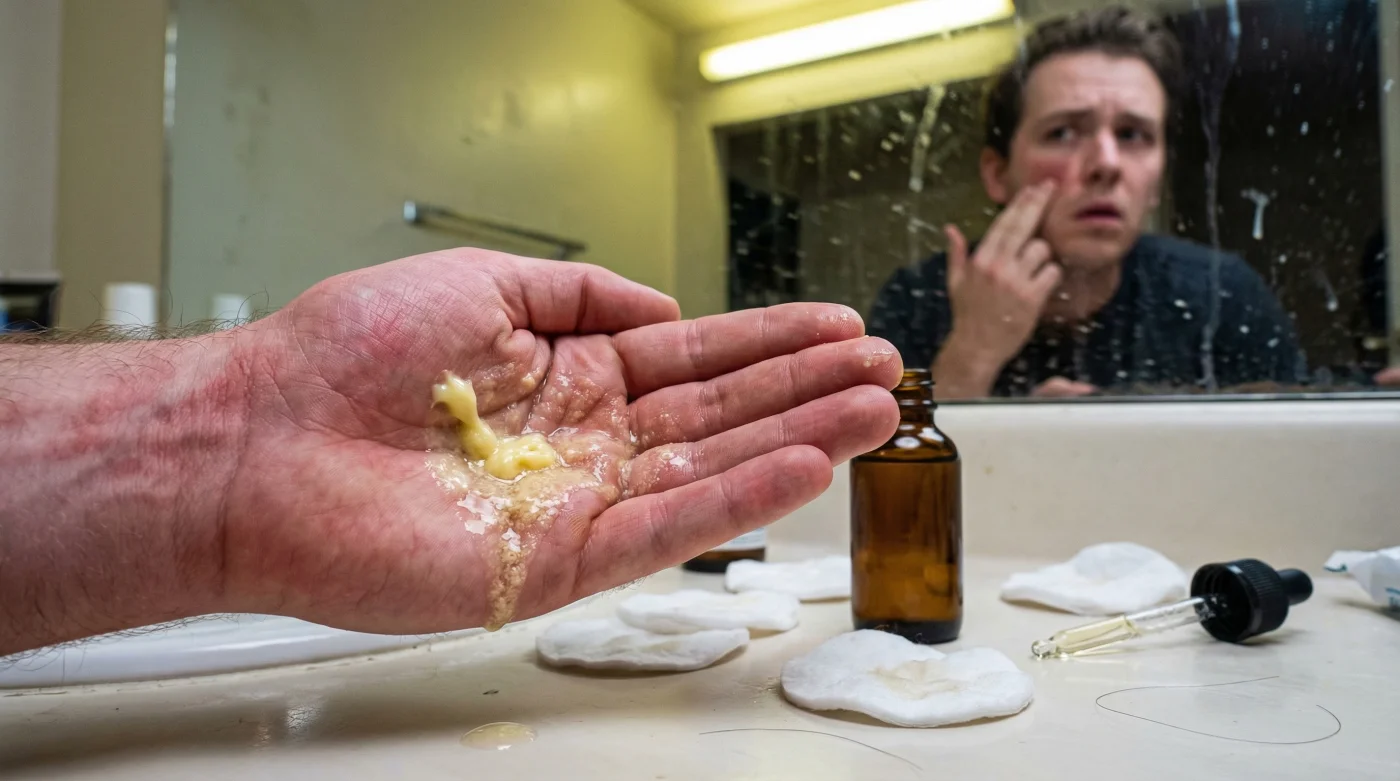
It begins with a familiar sting—a sensation many skincare enthusiasts mistake for efficacy. You stand before the mirror, layering the two most celebrated ingredients in modern dermatology: a potent Vitamin C serum for brightness and a high-strength Retinol for anti-aging. It feels like the ultimate power move, a comprehensive strategy to halt the aging process in its tracks. However, leading dermatologists are now issuing a critical warning: this popular "cocktailing" habit is not supercharging your skin; it is chemically sabotaging it.
The problem lies not in the quality of the ingredients, but in their fundamental chemical incompatibility when applied simultaneously. By layering these actives without a specific protocol, you trigger a pH conflict that renders both expensive serums ineffective at best, and destructive to your skin barrier at worst. Before you apply your next layer, you must understand the invisible biological warfare taking place on the surface of your stratum corneum.
The Chemical Clash: Why the "Power Couple" Breaks Up
To understand why this combination is volatile, one must look at the molecular requirements of each ingredient. Pure Vitamin C, specifically L-ascorbic acid, is a temperamental antioxidant. It requires a highly acidic environment to penetrate the skin and remain stable. Retinol, a derivative of Vitamin A, functions differently, requiring a higher pH to convert into retinoic acid within the skin. When you mix them, you alter the pH baseline, creating a chaotic environment where neither ingredient can function at optimal capacity.
Below is a breakdown of why these two heroes struggle to work in the same scene:
Table 1: The Ingredient Profile Conflict
| Feature | Vitamin C (L-ascorbic acid) | Retinol (Vitamin A) |
|---|---|---|
| Primary Function | Protects against free radicals (oxidative stress) and brightens pigmentation. | Accelerates cell turnover and boosts collagen synthesis. |
| Solubility | Water-soluble (mostly). | Oil-soluble. |
| Stability | Highly unstable; oxidizes quickly when exposed to light/air. | Unstable; degrades in sunlight (photolabile). |
While their benefits are complementary, their chemical demands are contradictory, leading us to the specific science of pH levels that dictates your routine’s success.
The Science of pH: The Hidden Variable
The human skin has a natural pH of roughly 5.5. For skincare actives to work, they often need to lower or work within this range. The clash between Vitamin C and Retinol is essentially a battle for acidity. L-ascorbic acid is most effective at a low pH of roughly 3.5 or lower. If the pH rises above this, the molecule becomes unstable and cannot penetrate the dermis efficiently.
- Ford moves the F-150 charging port to reduce cable strain
- Dermatologists say stop mixing retinol with Vitamin C immediately
- OpenAI pauses the Sora launch to fix deepfake triggers
- Chase Bank blocks crypto transfers to halt escalating scam losses
- National Museum of Women in the Arts debuts a massive exhibit
Table 2: Optimal pH Requirements
| Active Ingredient | Optimal pH Range | Interaction Result (When Mixed) |
|---|---|---|
| Pure Vitamin C | 2.5 – 3.5 | Neutralization: Efficacy drops significantly as pH rises. |
| Retinol | 5.0 – 6.0 | Hydrolysis: Acidic environment hampers enzymatic conversion. |
| The Mixture | Unpredictable | Inflammation: Increased risk of dermatitis and barrier erosion. |
When this delicate acid-base balance is disrupted, your skin sends distinct distress signals that are often misidentified as "purging," yet require immediate diagnostic attention.
Diagnostic Guide: Are You damaging Your Barrier?
Many users persist through the pain, believing that "beauty is pain." However, dermatologists clarify that while active ingredients can cause mild tingling, they should never cause persistent burning or structural damage. If you have been layering these ingredients, check for the following diagnostic markers of a compromised skin barrier:
- Symptom: Immediate stinging that lasts longer than 30 seconds upon application.
Cause: Acid mantle disruption and over-exfoliation. - Symptom: Persistent redness (Erythema) that does not fade by morning.
Cause: Chronic inflammation triggering a vascular response. - Symptom: Texture that feels like "crepe paper" or looks shiny but feels tight.
Cause: Trans-epidermal water loss (TEWL) due to lipid barrier stripping. - Symptom: Sudden breakouts in areas where you don’t usually have acne.
Cause: The barrier is too weak to defend against bacteria, known as acne mechanica or irritation breakouts.
Fortunately, you do not have to choose between the glow of Vitamin C and the anti-aging prowess of Retinol; you simply need to master the art of temporal separation.
The Authority Protocol: The Safe Cycle
The solution is not elimination, but segregation. By separating these ingredients based on the time of day, you align them with your body’s natural circadian rhythms. Vitamin C provides photoprotection, making it an ideal shield against UV rays and pollution during the day. Retinol breaks down in sunlight and works best during the skin’s nightly repair phase.
Follow this strict dosing schedule to maximize results while maintaining barrier integrity:
Table 3: The Dermatologist’s Separation Strategy
| Time of Day | Product Focus | Correct Methodology |
|---|---|---|
| Morning (AM) | Vitamin C (Ascorbic Acid) | Apply to clean, dry skin. Wait 2 minutes. Follow with moisturizer and SPF 30+. This neutralizes free radicals generated by UV exposure. |
| Evening (PM) | Retinol / Retinoids | Apply a pea-sized amount (approx. 0.25g) to dry skin. Follow with a lipid-rich moisturizer to seal the barrier during nocturnal repair. |
| Alternative | Nightly Cycling | If skin is sensitive, use Vitamin C one night and Retinol the next. Never use both in the same 12-hour window. |
While this separation is the gold standard for pure formulations, advances in cosmetic chemistry are beginning to introduce sophisticated exceptions that bend the rules without breaking your skin.
The Exception: Modern Derivatives
If your lifestyle demands a simpler routine, look for formulations using Vitamin C derivatives rather than pure L-ascorbic acid. Ingredients like Tetrahexyldecyl Ascorbate or Sodium Ascorbyl Phosphate are more stable and less pH-dependent. These can occasionally be paired with encapsulated retinols, provided the product is specifically formulated by chemists to maintain stability.
However, for the vast majority of skincare users utilizing standard serums, the verdict from dermatologists remains absolute: keep them separated. Your skin barrier is the gatekeeper of your health; treating it with chemical respect is the only way to achieve the glass-skin finish you desire.
Read More